
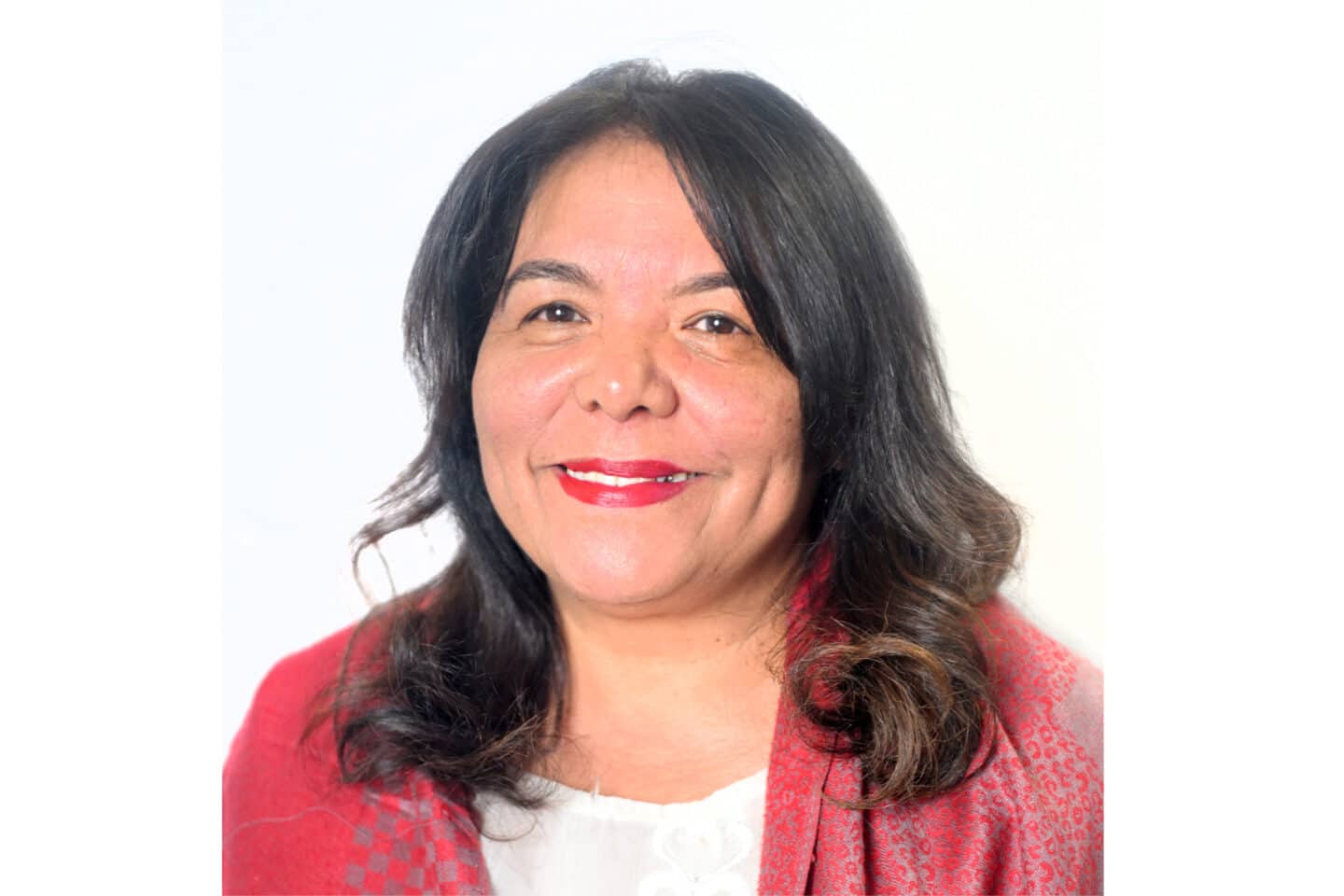
We are delighted to welcome Professor June Bam as Lincoln’s first AfOx Visiting Fellow. The AfOx Visiting Fellowship Programme enables exceptional African researchers to build international networks and pursue a project of their choice in collaboration with Oxford-based scholars. Fellows are affiliated with the University of Oxford for 12 months, including a two-month residency in Oxford. We look forward to collaborating with June during her time at Lincoln this Trinity term.
Below, June reflects on the experiences that shaped her scholarship, activism and research interests.
I was born in Cape Town in an Apartheid hospital for ‘blacks’ in the former Slave Cape Quarter during a period of great suppression in the 1960s in South Africa. This was the time of the Rivonia Trial when Nelson Mandela and many other political prisoners were incarcerated on Robben Island ‘for life’. I grew up at a time when black activists (including those as young as 16 years of age) were sentenced to death and hanged in Pretoria for fighting a crime against humanity. I remember growing up in this political climate of immense state violence and fear for the Apartheid police, and of daily hearing mysteriously whispering adults speaking in proverbs and languages we did not understand as children, and of secret adult gatherings at night in kitchens organising political ‘things’. The police vans arrived frequently, raiding homes looking for ‘Africans’ ‘without a pass’.
The place I grew up in was a place of racial integration, regular cultural ceremonies and rituals, and being regularly infused by the ‘Ausi’ in the family with medicinal healing herbal baths. The ‘Ausi’ were the big and important respected older female figures who lived around the wetlands and taught the children in the surrounding veld about observing important signals in nature.
Life for children amongst the aromatic Cape fynbos was somehow a little magical and reassuring as we were taught how to survive should a natural disaster strike. But this self-sustaining community was like others violently disrupted by Apartheid forced removals in the 1970s and we were forced to settle in designated demographic areas (some far away) as separate ‘races’ with our movements regulated by a multitude of segregation laws. The ‘Ausi’ women were forced into labour in the factories and as domestic workers in white homes and treated as ‘illiterate’ people ‘without knowledge’. Displaced from the wetlands and sustaining ecologies, new generations from them succumbed to addiction and criminal gangster activities to survive as we see today in the Ross Kemp documentaries of ‘the world’s most dangerous gangsters’ and in the film ‘Zulu’. This is where I grew up.
As a junior, I attended the Cape Flats Distress Association primary school where the teachers ‘beat out’ indigenous knowledge of the ‘Ausi’ out of us as not to be in ‘trouble’ with the regular visiting school inspectors with their folders of ‘notes’ on subversive teacher activity.
At high school, I was recruited to join the banned underground struggle at the age of 14 years. The ‘underground’ cell constituted a reading group that met clandestinely. I was the youngest member (and the only girl) in a small reading group where I read about women leaders in political organizations and as activists and philosophers – amongst them, Cissie Gool of the Unity Movement, the resilience of Domitilla Barrios de Chungara on the Bolivian mines, and the intellectual contributions of the European Rosa Luxemburg on ‘self-determination’.
I resisted criminal gangs invading our school and got brutally beaten up by these violent males on two separate occasions at the ages of 14 (on the school grounds) and at 16 (in the street on my way to a science study group) because I did not want them to disrupt our education and attack the girls. They frequently invaded our schools to ‘fetch a child’. What struck me at the time (notwithstanding the trauma of the physical violence suffered) was that these were all young men. Later in life, I would come to understand how our communities suffered the long haul of colonial oppression and Apartheid displacement and the resultant dehumanization, gender-based violence and brutalization.
My real dream was to study medicine and health sciences, but I was tersely turned away by the unfriendly white matron at the local Somerset Hospital that radiography was ‘whites only’ and ‘not for Coloureds’. I instead ended up teaching as an unqualified teacher at my high school at age 17 to recruit youth to the underground struggle to fight Apartheid.
From Grassy Park High I was recruited to study for a Bachelor of Arts degree at the white ‘Oxford’ (as it was called then), the University of Cape Town (UCT) – though on special permission from the Minister of Education in Pretoria to study as a ‘Coloured’ at a white university. UCT had strict academic admissions criteria and I was pleased to be successfully admitted on merit to study courses in languages, African History and Archaeology.
Thereafter, at postgraduate level, I studied History Education with erudite female scholars like Professor Melanie Walker at UCT. I studied up to Master’s degree level at UCT (with a focus on historiography and education) and did my PhD in History Education and Sociology at the University of Stellenbosch. Historiographical Studies became my passion because it is so integral to understanding the way in which the study of the past has been a construct in the Eurocentric disciplines and how the indigenous knowledge of the past of oppressed and marginalised people has been deliberately excluded.
The AfOx Visiting Fellowship
As a result of years of engaged research and work with youth and women, I wrote my monograph Ausi Told Me: Why Cape Herstoriographies Matter (Jacana, 2021). This journey brought me to apply for the AfOx Fellowship as it provided an opportunity for a global collaboration and lens on world history and the often-invisiblised epistemologies of surviving intergenerational Khoi-San cultures through the ‘Ausi’ and ‘deep time’ knowledge of plants.
AfOx provides research and networking opportunities to work with lead scholars and thought leaders in global historiography such as with my Oxford collaborator Professor Peter Frankopan, author of the groundbreaking book The Earth Transformed: An Untold History. For me, the ‘Ausi’ came vividly alive as a bearer of valid knowledge of the long and interconnected past between Frankopan’s pages. After reading the last pages of this book, I decided to write to Frankopan and we started a conversation on shared scholarly interests. This led me to apply for the AfOx Fellowship with Peter as my agreed promoter. When I learnt I was successful, we were both thrilled because these fellowships are very competitive. It is an incredible opportunity to bring my own voice to scholarship on Khoi-San cultural and epistemological heritage as a formerly oppressed person. Frankopan’s confidence in my work – and support for my work as a woman who grew up under Apartheid with all its various marginalizations – is very inspiring.
Research interests
My research troubles the ‘extinction’ and ‘disconnected people and culture’ discourse. Ausi knowledge contributions have been absent from acknowledgment in the scientific and heritage disciplines. In ‘deep listening’ to ‘conversation’ in the ‘anarchive’ (‘seeing what is not there’), the matrifocal interconnected Ausi exists, as illustration’ in the deep-time knowledge of plants worldwide.
In my time as an AfOx fellow, I am conducting collaborative research on how could we rethink global ‘precolonial’ historiography from the perspective of the Khoi- San Ausi’s indigenous deep-time plant and landscape knowledge as interconnected ‘anarchive’ in the relevant and dispersed collections held in Empire. I am conducting research with relevant archives, herbariums, museums and libraries in the UK that hold significant, vast unexplored and uninterpreted data (from an African feminist indigenous perspective). This is also true of the Pitt Rivers Museum with its large collection of Khoi-San artefacts, without interpretation from the ‘Ausi’ perspective. Ausi was an unacknowledged voice in the British colonial collection and curation practices at the Cape of Good Hope.
I am honoured and thrilled to be at Oxford and Lincoln College (with its own notable women’s history of epistemological exclusion close to 600 years) and to have the opportunity to research and write a follow up volume to my monograph Ausi Told Me, provisionally titled, Global Herstoriography Matters: An African feminist decolonial perspective through the lens of Cape medicinal plants.
I am a proud mother of two adult sons and grandmother to a 17-year-old granddaughter.
You can read more about June and her work here