Portrait of John Wesley.
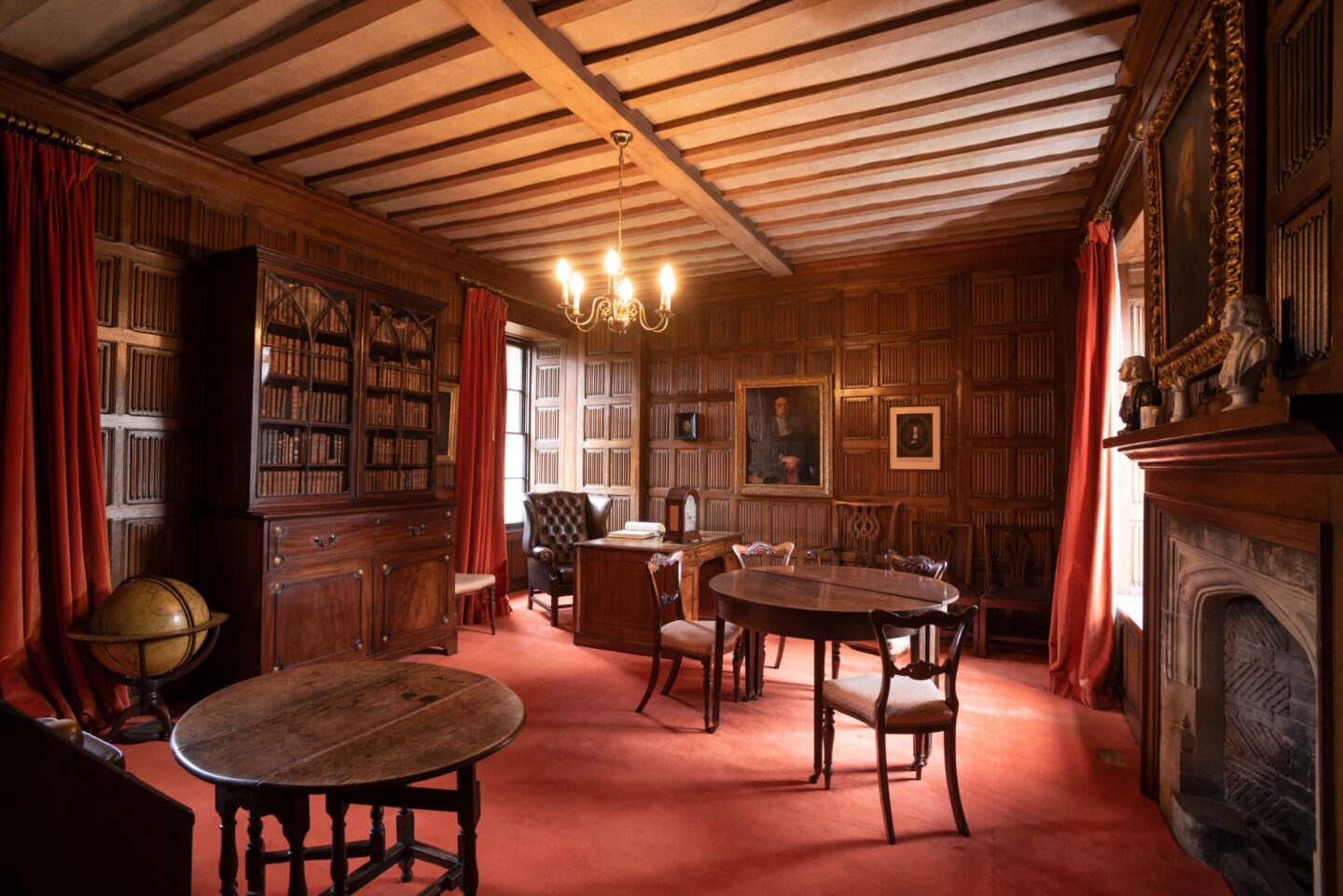
John Wesley Room, Lincoln College, Oxford.
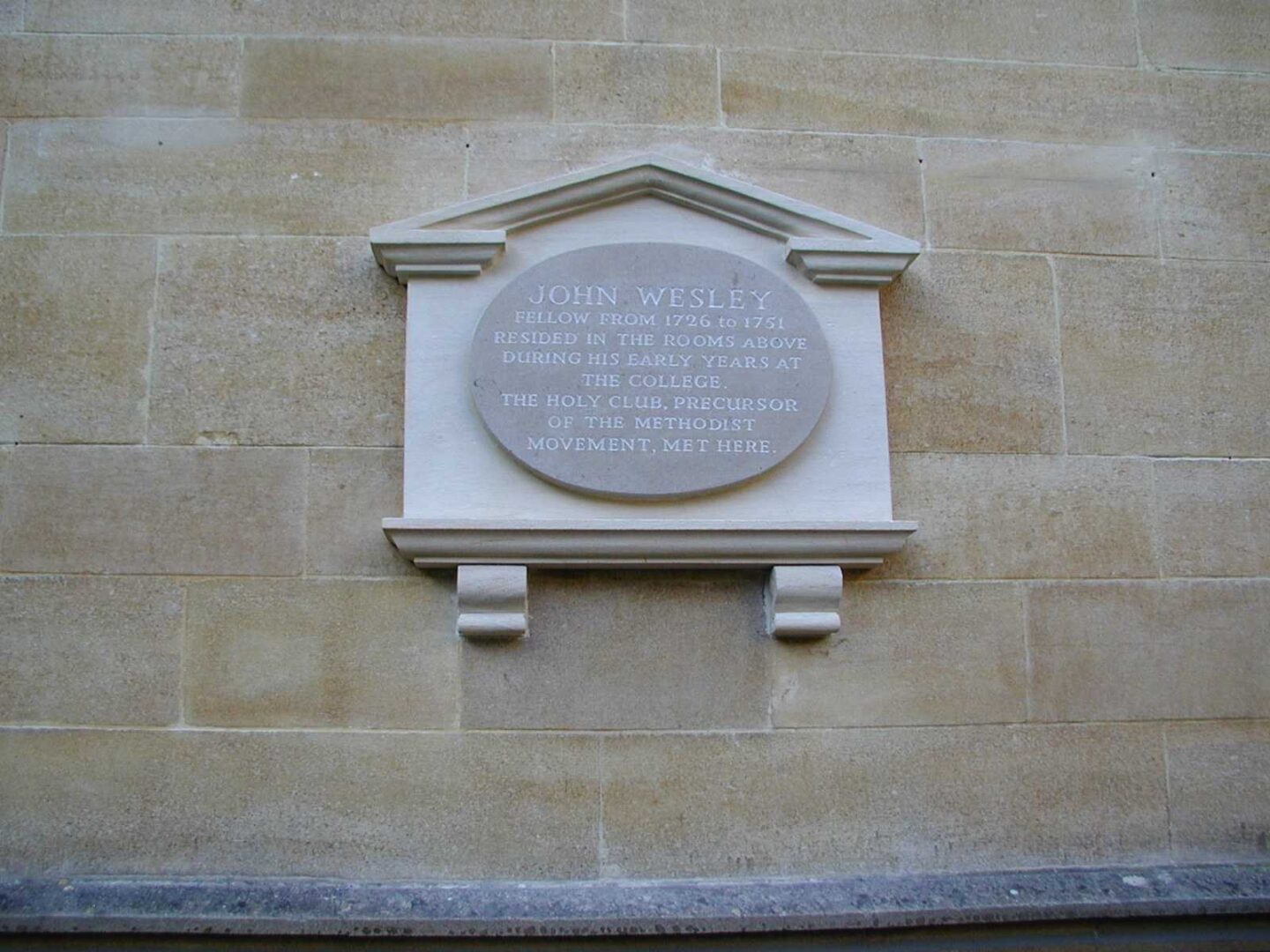
Memorial plaque at Lincoln College, Oxford, commemorating John Wesley.
28 March marks the 300th anniversary of the appointment of probably Lincoln’s most influential Fellow, John Wesley, a Fellow of Lincoln from 1726 until his marriage in 1751. Wesley founded the Methodist movement, and through his teaching, organisation and constant itinerant preaching, wrought a significant change in British social and religious life.
I feel a strange personal connection to Wesley, since as Chaplain my office is in his former rooms. I often think of the fact that the Holy Club (the precursor to what would later become Methodism) met in the same space where students now have coffee and doughnuts and rather rowdy bible studies.
Wesley was born in 1703 into a clerical family and attended Charterhouse on a scholarship, before going to Christ Church. Throughout his undergraduate days he appears as a relatively typical 18th-century young man – often short of money, fond of cards, dancing and light literature, and with relatively few religious concerns.
The decision in 1725 to get ordained seems to have changed all this. Encouraged by his mother, who had great influence on John, he began to take a serious and significant interest in his faith. For instance, he started a diary in which he recorded rigorous self-examination. He was concerned by his constant frivolity, his wasting of his time, his failure to live up to his own exacting expectations. A particular pattern developed of creating stern resolutions to reformed living, and then breaking the resolutions within days, leading to further self-recrimination and new resolutions.
During this period, he was elected a Fellow at Lincoln. There was, apparently, some opposition to his appointment, not least because of his great seriousness. Some light ribbing in the SCR notwithstanding, all objections were overcome and his election was unanimous. He was to remain a Fellow until he married in 1751, despite being absent from Oxford for much of that time.
Whilst at Lincoln, Wesley joined with four friends, to form the Holy Club – a series of informally connected gatherings across Oxford. These young men, including John’s brother the famous hymn writer Charles, would spur each other on to acts of religious devotion. They spent many hours studying the Bible in its original languages, reflecting minute by minute on their use of time, and devising and carrying out schemes to support the poor.
It must be said that Wesley was never a massive fan of Oxford – he found it frivolous, heavy drinking, and lacking in religious seriousness. Perhaps inspired in part by these challenges, he left on a trip to the newly founded North American colony of Georgia in 1735. On the voyage he encountered Moravian spirituality from Germany, which had a profound impact on him, not least in its focus on spiritual experience. His intention was to act as missionary to the native population, but quickly he shifted his attention to the local settlers. This was not without its challenge, both because the settlers resented Wesley’s rather stringent version of Christianity, and because he became embroiled in a complex relationship with the niece of a leading figure in the community. Despite an early courtship, Wesley vacillated, and she married someone else. He left Georgia under some pressure, in part for excommunicating this former love interest.
The Wesley who returned to Oxford was not happy. Plagued by self-doubt, guilt and a sense of his own failure, he eventually found his way to a meeting in Aldersgate Street in London in 1738, where he heard someone read Martin Luther’s Preface to the Epistle to the Romans. The similarities between the young Luther and the young Wesley are striking – both shared an over-anxious conscience, a deep concern for personal holiness, and a sense of God’s demands on them that was not underpinned by a personal assurance of his love. It is, perhaps, therefore unsurprising that Wesley found Luther’s words so powerful, and that his heart was “strangely warmed” when the Reformer talked about God’s grace for sinners like him.
Whatever exactly happened, the event had a significant effect on Wesley and prompted the beginnings of the Methodist movement. Wesley took Luther’s view of justification by faith – that a person is made right with God on the basis of God’s grace alone – and yet developed it in a rather different direction. For Luther, and the more influential Calvin, a Christian’s relationship was based solely on God’s action in giving Christ, and not on a person’s deeds. “Works” were to have no place in salvation. Wesley likewise saw justification by faith as the entry point into religious life, but he then stressed the importance of a changed life as evidence of salvation. Most controversially, Wesley thought the pursuit of holiness and good works could lead to actual perfection in this life. The synthesis of Protestant theology with a holiness culture and a strong emphasis on spiritual and emotional experience proved hugely popular, and still influences many sectors of contemporary Christianity.
Methodism grew quickly in the years after 1738, as Wesley and his associates travelled tirelessly around the country, preaching in the open air to thousands. Initially intended to complement standard Anglican structures, the movement gradually gained its own momentum, and a distance grew between the denominations, especially once Wesley began increasingly irregular activities. By the end of Wesley’s life in 1791, there were Methodist communities across England and North America, and it was a significant player in national and international life, both religious and political.
Although in the UK Methodism has declined significantly, the Methodist church is still strong in many parts of the world. Probably its biggest contemporary influence is felt, however, through the Pentecostal movement which developed out of Methodism in the early 20th century. Pentecostalism is, by far, the fastest growing form of Christianity worldwide.
One final historical note, that bookends Wesley’s time at Lincoln: in 1751 he married Mary Vazeille, a widow of a London merchant. Since Fellows had to be celibate at the time, this necessitated his leaving the College. Sadly, the marriage was not happy. Wesley refused to reduce his constant travel schedule, and his fondness for female friendships (albeit platonic ones), did little to facilitate a happy home. Strained from the outset, their relationship broke down and she left him finally in 1776.
Wesley was, like all of us, a complex character, and I find it hard to assess the most famous occupant of my current office. He was, as are many leaders of radical change, a man of great charm, energy and enterprise. He also had a tendency towards authoritarian leadership and to falling out with friends. He worked tirelessly to promote not only his view of Christianity, but also the many causes he cared deeply about, including education and the abolition of the slave trade. Yet he struggled in affairs of the heart and caused much personal misery. I disagree with him on several theological positions he held dear, and I suspect he would have found me frivolous, unserious and lacking in holiness. Yet I cannot help being oddly proud that I hold bible studies in the same place the Holy Club met. We are, I think, rather less rigorous and intense, but would that we could have a fraction of the influence of our illustrious forebears.
Revd Dr Jonny Torrance
Chaplain
Support a Visiting Wesley Fellowship
To commemorate the 300th Anniversary of Wesley’s Fellowship we are raising money to support a visiting Wesley Fellowship. The post will examine social and cultural aspects of the 18th Century which may have influenced Wesley. To find out more please visit https://lincoln.ox.ac.uk/600/historic-lincoln/opportunities-for-support/.