Blog Post
Memories of Lincoln Rowing Across the Decades
Lucy Whiting
Campaign Officer
To celebrate 50 years of the Lincoln College Boat Club Society (LCBCS), we invited alumni to share some of their favourite memories of rowing at Lincoln. The three alumni featured below look back on moments from across the Club’s history: from Anthony Davey’s attempt to row from Folly Bridge to Westminster in a day, to Stuart Frodsham’s recollections of a 1976 Boat Club dinner that ended rather more memorably than expected, and Jeremy Lawford’s years in the cox’s seat in the 1950s.
They also generously donated a range of items to the Boat Club, including original LCBCS documents, a tie, hat, scarf and blazer, a DVD of the 1966 attempt to row from Folly Bridge to Westminster, and a selection of newspaper cuttings. Several of these items are now on display in our current exhibition, which can be found opposite the MCR.
Together, these stories and objects offer a glimpse of the friendships, challenges, mischief and characters that have shaped Lincoln rowing over the years.
Folly Bridge to Westminster
- Anthony Davey (1963)
8 June 1966 - Why not row from Oxford to Westminster? In one day. And break the 1824 record of 15 hrs 30 minutes set by six hefty guardsmen (well, they must have been hefty, mustn’t they?). And in the new eight, christened ‘Wilf Bossom’ in honour of the College boatman who’d retired the previous year after 48 years with Lincoln.
Folly Bridge at 5:45am, under the eye of a policeman we’d rounded up to make the start time official, oars caught the water, next stop Westminster Bridge.
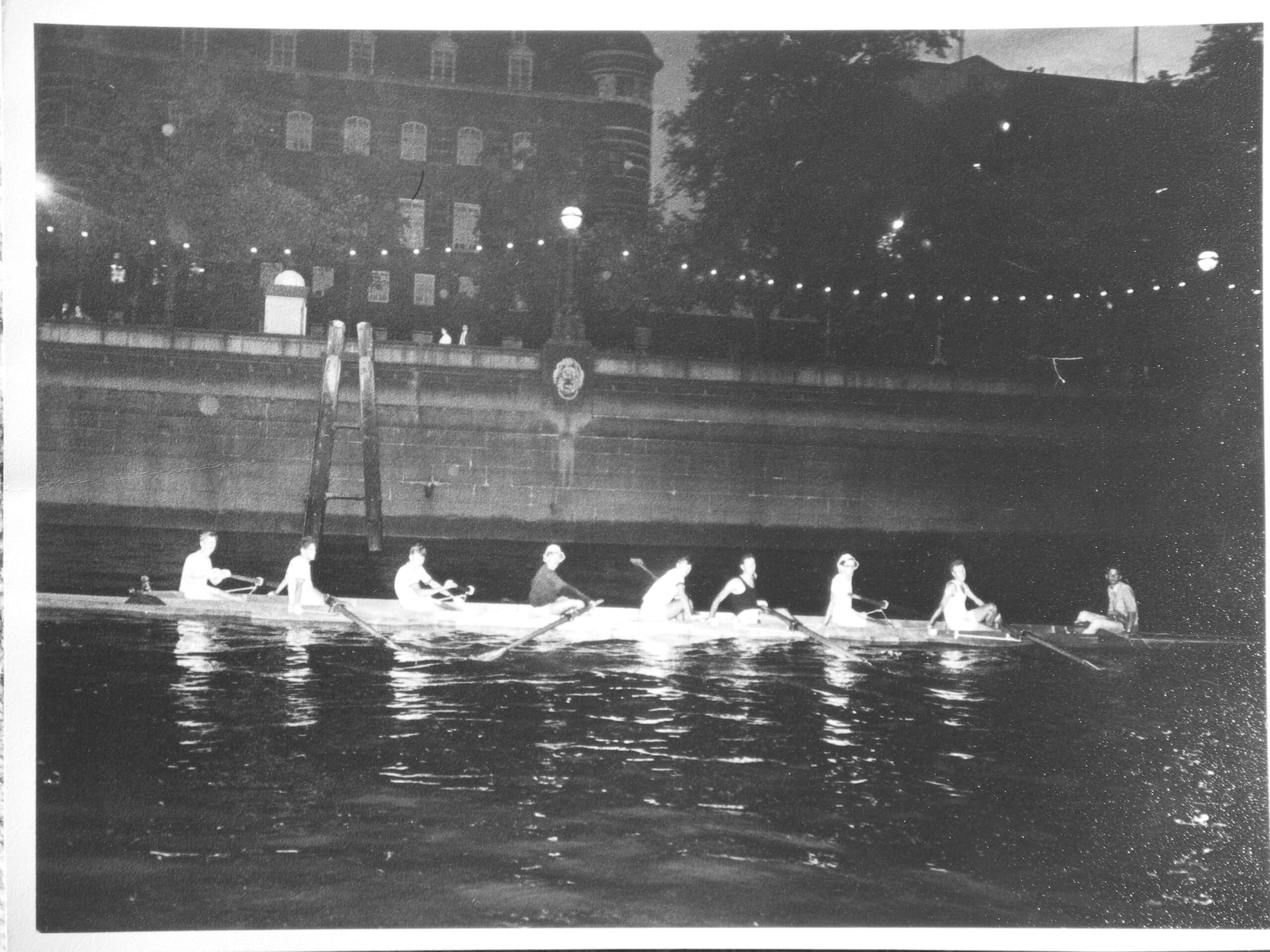
The crew was mostly our first eight, but in the engine room five and six were friends from other colleges helping out. The cox was our exuberant George Stainton (1964) who was very taken with his loudhailer, and warned the cows in the fields that the “Lincoln Imperials” were passing. Fortunately, he’d dropped this embarrassing moniker by the time we reached Radley.
Thirty-three locks were in the way and each had to be opened, filled, closed and emptied. The Thames Conservancy had helpfully agreed to give us priority, holding other traffic to pass us through. Peter Farmer (1964) and Peter Sylvester (1964) did a heroic job of recruiting and organising three carloads of supporters to leapfrog each other all the way to Richmond to work every lock as we approached. As the day progressed, these supporters plied the crew with water, honey, salt tablets and encouragement. We’d have got nowhere without them.
We had a detailed timetable, official clearance from the Proctors, thick foam rubber on the seats, sunhats, and some of us wore gloves. Nothing could go wrong, obviously. For the first few locks we were on time, the supporters slid us efficiently through, and we could enjoy the cowslips and buttercups in the water meadows. Iffley, Sandford, Abingdon, and Culham passed, but we were a minute late at Culham. By the time we’d passed Hambleden lock and reached Henley the boat was behind time, the sun and humidity were becoming oppressive, and a short comfort break was necessary.
The break encouraged us, and George took the rate up a bit. Sixteen locks behind, 17 ahead. But in mid-afternoon our stroke, David Hourston (1964), began swaying about, muttering, and losing the plot; he’d refused any salt tablets and was becoming delirious. At the next lock John Newth (1964) took stroke, David took John’s four seat and made an astonishingly quick recovery with salt and water.
As twilight approached, the boat passed Richmond lock and entered the tideway. The ebbing tide gave us a bit of help, badly needed by this stage. From Battersea the captain’s brother ran along the towpath cheering the crew on as the light failed. But we were tired, and had to rest on our oars every 50 or 100 strokes. The boat emerged through Westminster Bridge after 15 hours and 45 minutes. We came ashore to a great welcome from Lincolnites and families.
Fifteen minutes behind the record and my bum didn’t stop hurting for a month.
The LCBC Annual Dinner 1976
- Stuart Frodsham (1974)
In 1976, Lincoln was still all male. I was captain of boats and we had had a good Summer Eights with three bumps to finish 10th in the first division. The Boat Club dinner was held at the Eastgate hotel in the High. It was well attended and the mood jubilant.
The following morning coming out of breakfast, I was met by the porter with an urgent message. The manager of the Eastgate Hotel required me to report to him within the hour or he would call the police! On presenting myself, he complained the ceiling in the dining room we used was covered in butter and four of the small college shields decorating the walls were missing.
On returning to College, I was met by Paddy Robathan (1974), our JCR president. He explained that the Dean, John Owen, wished to see me immediately and Paddy suggested he accompany me.
John was such a gentleman, but I knew I was in deep trouble when he sat us down and offered us sherry (mid-morning). He then presented me a bill for damage done around the College the previous evening.
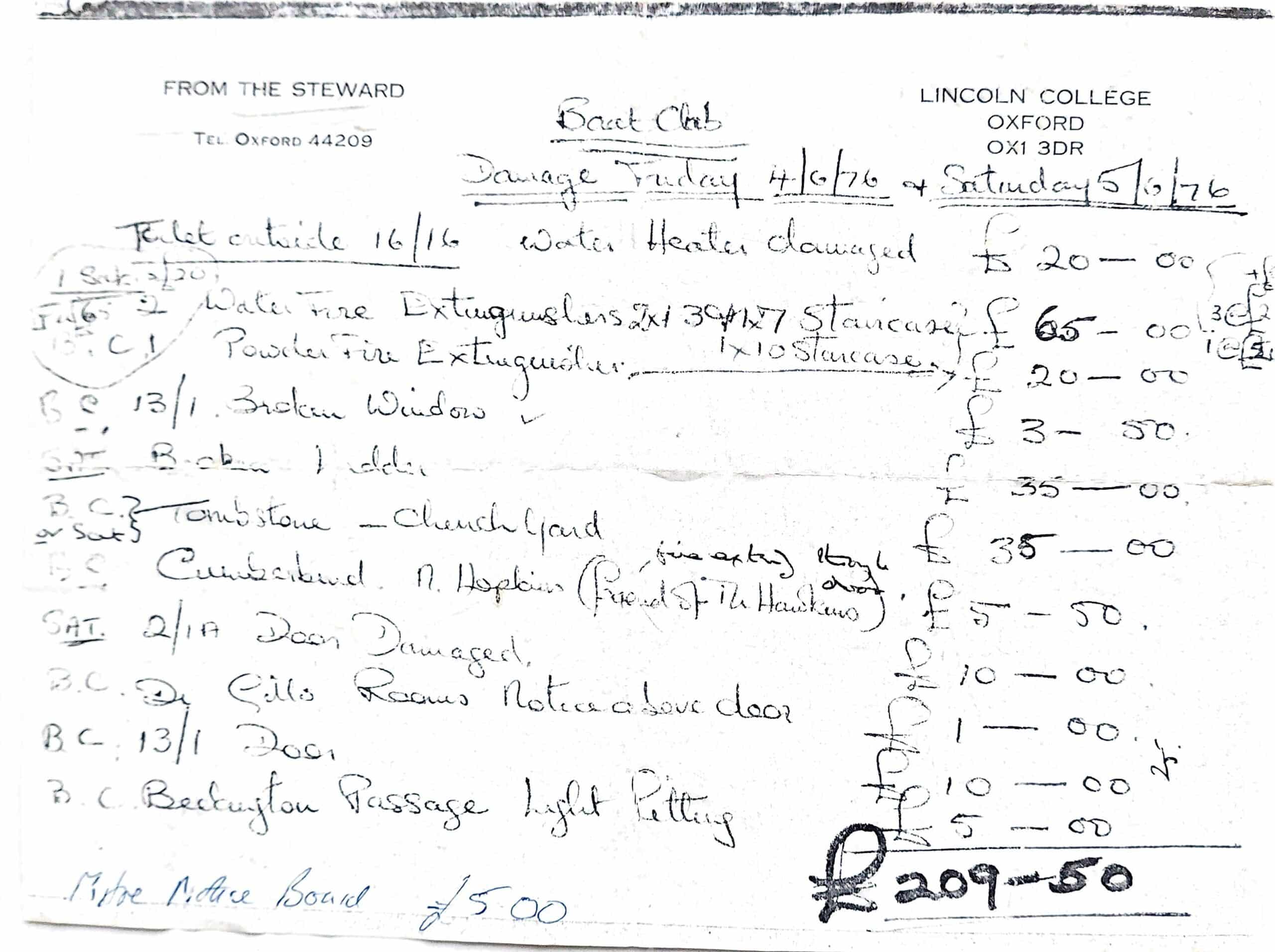
£209 was a lot of money in those days. Among the bigger items was a damaged new set of ladders, which I denied any responsibility for on behalf of the club. (I hasten to add, I had been unaware of any of the high jinks going on and was completely taken by surprise). Paddy proved his worth by reporting that a group of visitors from the ‘other place’ (Cambridge) had been on the rampage in and around the College the previous evening. We very amicably agreed a figure of around £30 to cover some of the minor items, which we would try to recover from those responsible.
A week later I happened to bump into John in Front Quad. He told me that he thought the Boat Club might have had something to do with the ladders. He explained they had been found in Front Quad, propped up against the bust of John Wesley and he was wearing a Boat Club blazer!
LCBC and me
- Jeremy Lawford (1956)
Down to the river
My involvement in Lincoln College Boat Club (LCBC) came about in a completely unexpected way. When I went up to Lincoln at the start of Michaelmas term 1956, I looked for some form of sporting activity. At school I had done a bit of running, so I decided to try cross country. As it happened, the College’s star performer, DJN Johnson (1953), was away at the time representing Great Britain in the Brisbane Olympics, so there was a vacancy in the team, which I filled with complete lack of distinction for the first few weeks of term.
Then, one day, two gentlemen called on me in my rooms overlooking the Turl on staircase one. They were Howard Lyle (1955) and Dunkin Symes (1955), Captain and Secretary of the Boat Club. Had I ever considered, they wanted to know, coxing an eight on the river – a question to which I was able, without hesitation, to answer ‘no’. Would I like to come down to the river and give it a try? To be honest, the cross country was not going particularly well and Derek Johnson would soon be back from Australia, bemedalled with silver and bronze, to reclaim his rightful place. My days in the team were numbered, so why not give it a go? That was the start of a journey which led to very many afternoons over the next two years spent happily in boats on the river, and spending time with many delightful people.
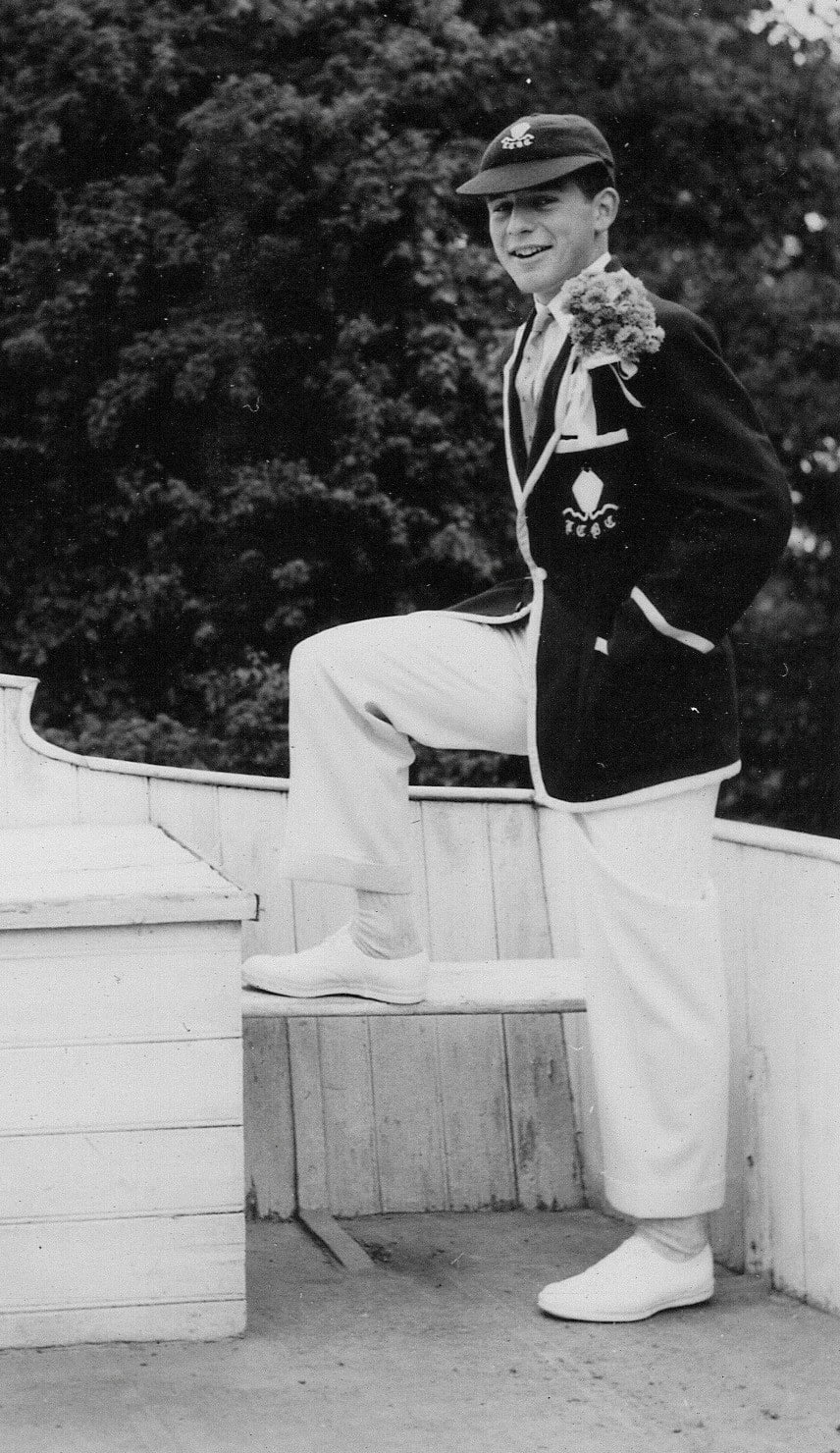
Paddle on bow!
I don’t remember much about the early stages. I must have taken to the sport reasonably well because early in the new year I was at Putney with the First Torpid, training on the Tideway. I think I picked up rowing jargon quite quickly, but I remember being baffled on one occasion when, after a strenuous workout, I asked bow to “paddle on” and heard the anguished response “I can’t paddle on, cox, I’m shooting the cat!” This expression, it turned out, meant that the poor chap was being sick. In the actual races, we made two bumps (and claimed a third, but none of the umpires had been watching).
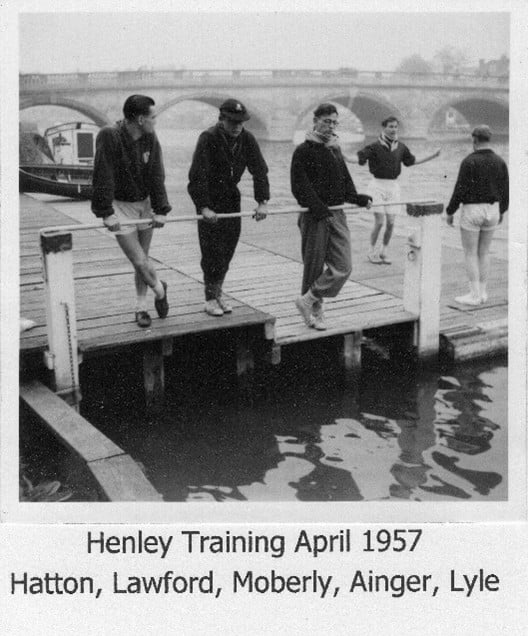
Before the start of Trinity term, two crews spent a week training at Henley, and staying at a guesthouse owned by Mr and Mrs Dudley Colley – known to us, inevitably, as the Cuddly Dollies. We were expecting to do reasonably well – we had two Trial Caps, Hall and Moberly, at six and seven, and a strong and experienced crew who worked well together. On the first night of Eights, we rowed over at the top of the Second Division and then bumped Univ to establish ourselves at the foot of the First. Two more bumps followed and hopes were high for the last night – so high, indeed, that a Bump Supper was arranged by the College. Alas, we failed to catch Trinity, despite achieving a brief overlap. Everyone was too kind to blame the cox, except the cox himself. All in all, it had been a very successful Eights Week, in which none of our four boats was bumped, and we enjoyed our Bump Supper very much.
In June we competed on successive Saturdays at Wallingford, Reading and Marlow. We then defeated Trinity Hall Cambridge in the eliminating races at Henley but our active participation in the regatta ended early on the first day, when we lost to LMBC in the first round of the Ladies’ Plate. We were disappointed, but were able to enjoy to the full all the delightful facilities of the Stewards’ Enclosure over the next three days.
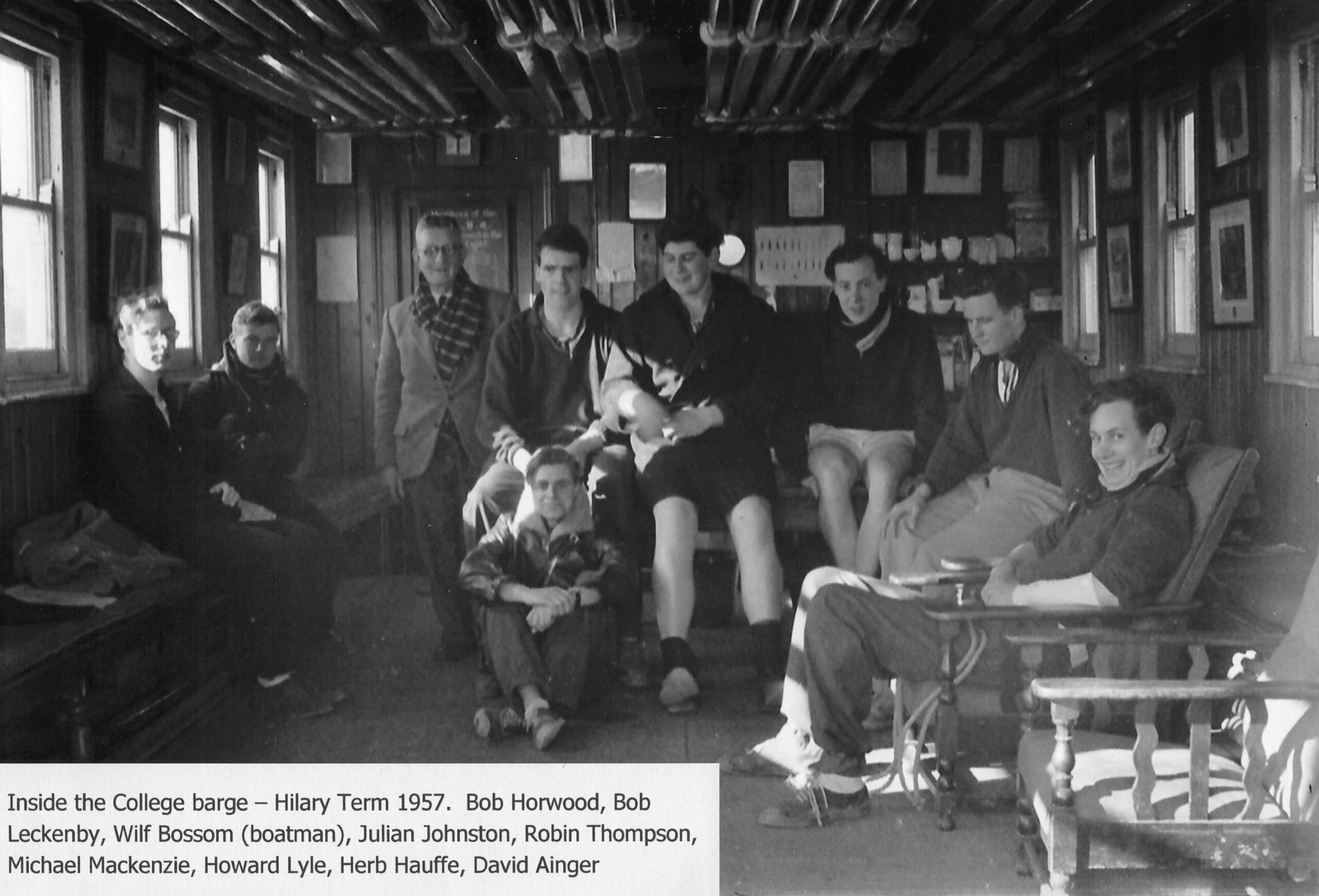
Two important events in the life of LCBC occurred during the year. The first was that the venerable College barge was decommissioned, and we moved into the new boathouse, shared with Oriel and Queens’. And Dunkin Symes, as Treasurer of the LCBC Fund (founded in 1953), compiled a register of former members and appealed to them to sign covenants. Many responded positively, and the finances of the Boat Club were greatly improved.
Pulling strings
In Michaelmas term 1957 I was lucky enough to be selected for the OUBC Junior Trials, and after the race at Henley in early December I coxed the Isis crew in training for a time. After that it was too late to take an active part in Torpids, so I helped with the coaching of the second crew and then coxed a scratch eight which was entered for the Reading Head of the River and advanced to 40th from its starting position of 68th.
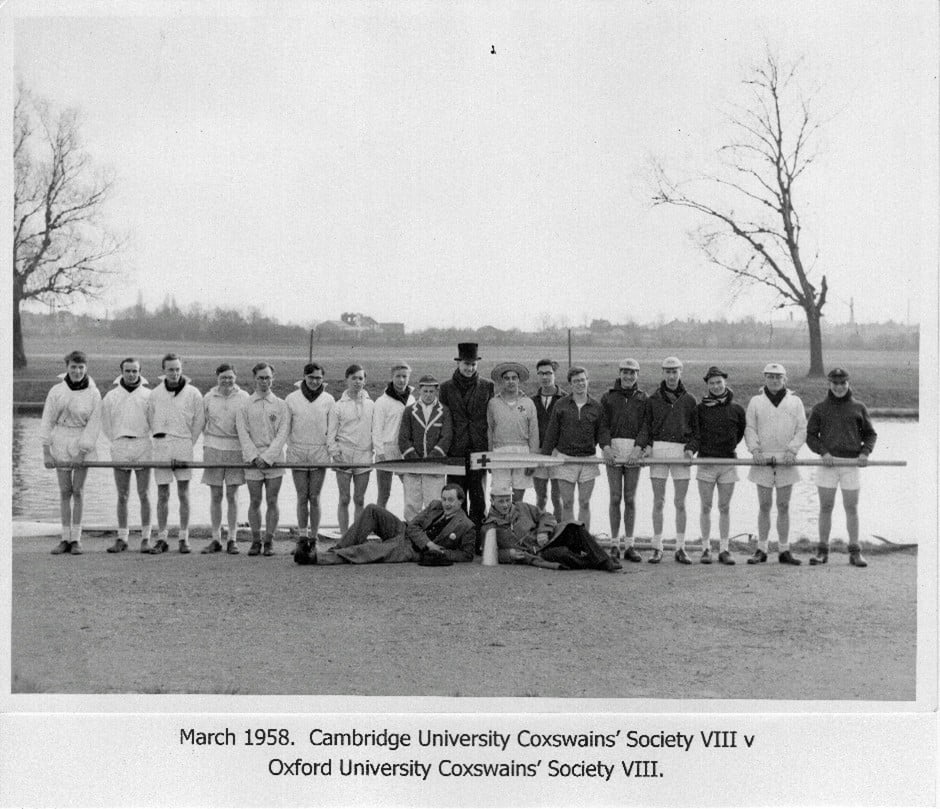
An amusing diversion in March was the annual race between the Oxford and Cambridge coxswains, in preparation for which each crew was allowed a maximum of five outings. I enjoyed the experience of rowing for a change, but of the race itself I remember only a cold and bleak afternoon on the Cam – and Oxford lost!
Once again, two crews trained at Henley before the Trinity term. We approached Eights Week with a fair degree of confidence, though there was some doubt as to whether we were quite as fast as the year before. The first night was nearly disastrous – on what we thought was the minute gun, we saw the boat behind going off at great speed - evidently our counter-down had miscounted! We recovered fairly quickly but were lucky to escape from Hertford who were only a few feet behind at the Gut. We bumped Trinity and New College but just failed to catch Jesus on the last night. The 2nd VIII had the unenviable record of rowing over at the top of Division Three but being not quite fast enough to catch the last boat in Division Two – eight races in four days!
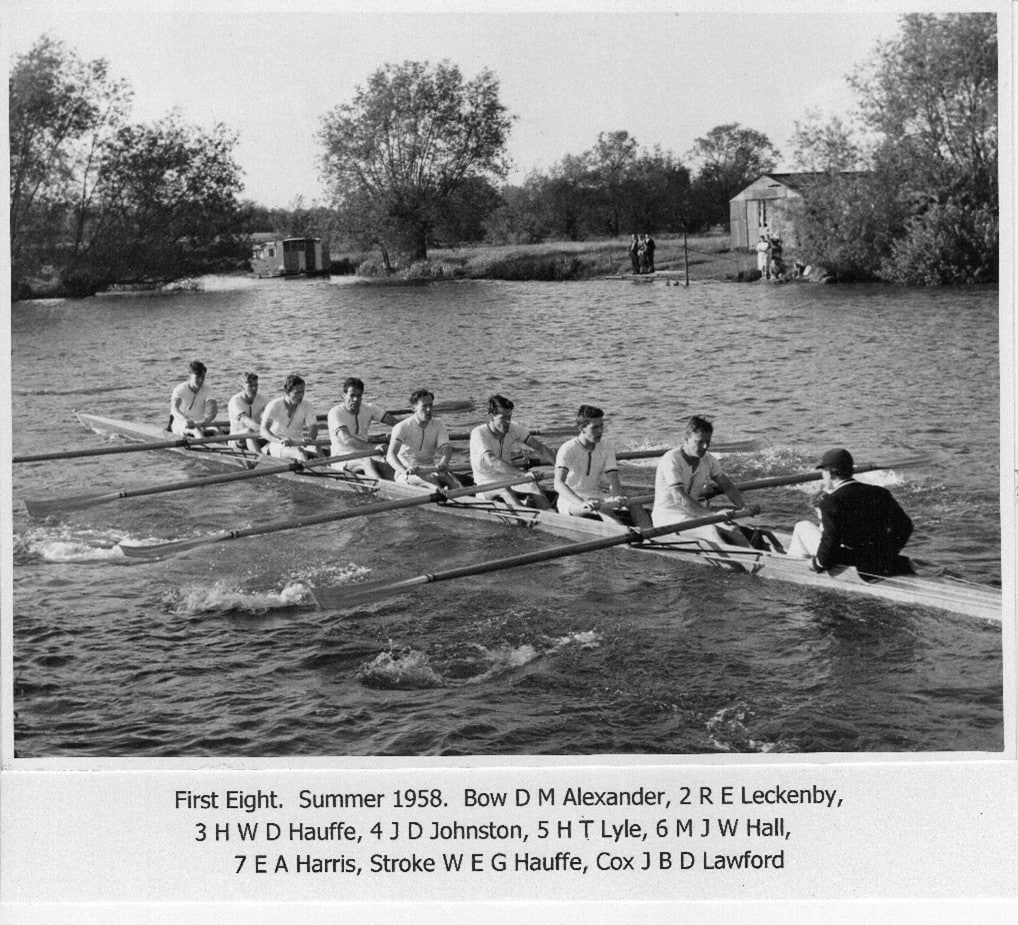
The preparation for Henley was disrupted by Schools. Jonathan Hall (1956), who had won a Blue in the Boat Race earlier in the year, left to focus on his pair, in which he and Stuart Douglas-Mann (St Edmund Hall) managed to beat the reigning European Champions in the Empire Games Trials. Eventually an eight was assembled about two weeks before the regatta, but we lost narrowly to Oriel in the first round of the Thames Cup, despite having led to Fawley and beyond.
I stayed on for a few days after Henley to help Hall and Douglas-Mann with their preparations for the Empire and Commonwealth Games. I was sorry not to be able to support them in Cardiff, where they won a silver medal, but by that time I was well on my way to Greece with Howard Lyle (1955) and Herb Hauffe (1956) in Herb’s 1939 Standard Nine!
In the annual newsletter to supporters of the LCBC Fund, I was able to report that in Torpids and Eights over the last two years, Lincoln boats had only been bumped three times and had moved up a total of 23 places.
Trials and after
Once again, I was involved in Trials in the Michaelmas Term, this time the senior version. We trained at Wallingford, but the actual race was at Henley, on the regatta course but rowed downstream, with a finish well beyond Temple Island. It was a very close race, and the two coxes incurred the disapproval of The Times rowing correspondent by showing “a willingness to risk a clash which can seldom be justified”. However, Clive Shakerley (SEH) and I knew what we had to do, and he didn’t! I preferred the comment of Olympic gold medallist Charles Livingston Grimes (ChCh), as expressed in his Christmas card: “Quite some steering during Trials!”
A few days before the race I had travelled in the rather daunting company of Group Captain HRA “Jumbo” Edwards, the Blue Boat coach, to Cambridge, where we were both guests of the Cambridge University Coxswains’ Society at their annual dinner.
My OUBC involvement ended with a strange race on the Tideway a few days before Christmas, in which I coxed the eventual Blue Boat. I think it was organised by Thames Rowing Club and was called the “Christmas Pudding Regatta” or something of the sort. It took place on the Boat Race course which remained open to normal river traffic. From a cox’s viewpoint that was decidedly challenging!
With Finals looming, my further participation in boating activity was limited. Once again, I helped to coach the 2nd Torpid, which bumped once. The first boat, starting third in the Second Division, made four bumps and finished firmly in the First, earning another Bump Supper.
The Coxswains’ Race that year, rowed on the Isis, attracted some slight notice in the press. In The Daily Telegraph, Peterborough opined, with tongue in cheek, that “it should be a rich sporting spectacle”, while the Oxford Mail rather unkindly reported that the “only similarity between this event and the Boat Race is that Cambridge usually win”. They certainly did on that occasion!
In Summer Eights, the first boat made two bumps and finished sixth. David Finch (1957) searched the records and discovered that this was the highest placing by a Lincoln crew since 1912 – and in 1960, if I remember rightly, we went two or three places higher. My last experience of coxing at Lincoln (or anywhere else, come to that) was with a rumbustious and largely ungovernable 4th “Schools” VIII which somehow achieved three bumps and was considered unlucky not to have managed a fourth. My weight, on the Eights Week card, was entered slanderously as 14 stones and 7 pounds!
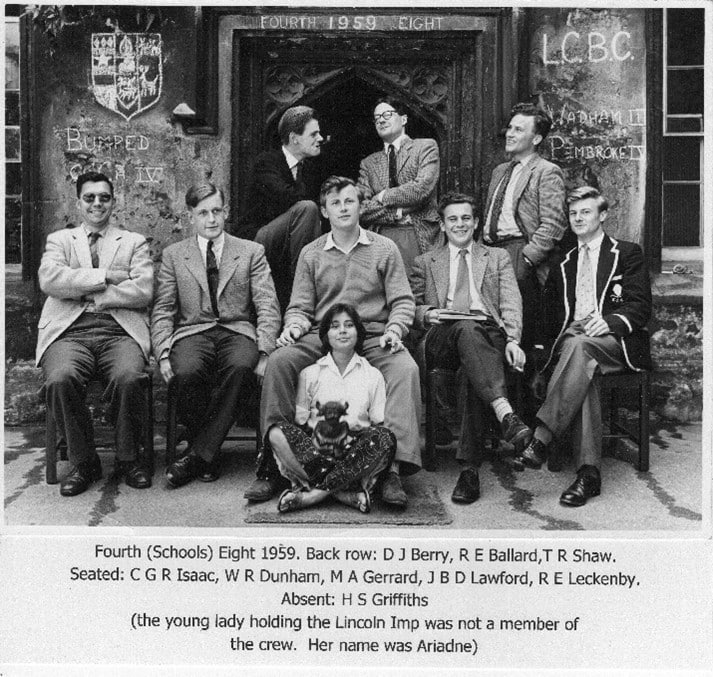
And that was it. Quite unexpectedly, I had been given the opportunity to participate in an outstandingly stimulating and successful period in Lincoln rowing. I had made friendships, which in some cases would last a lifetime. I am so glad that I gave up cross-country running!
Epilogue
For fourteen years I kept up my membership of the Stewards’ Enclosure and of Leander, but life took me to Scotland, Italy, and back to Scotland, and in all that time I was able to attend Henley Regatta just once. In 1973, married and with a first child recently born, I decided that the expense of membership could not be justified and I sent letters of resignation to both. The response from the Regatta Secretary was friendly, that from the Hon Treasurer of Leander somewhat brusque!
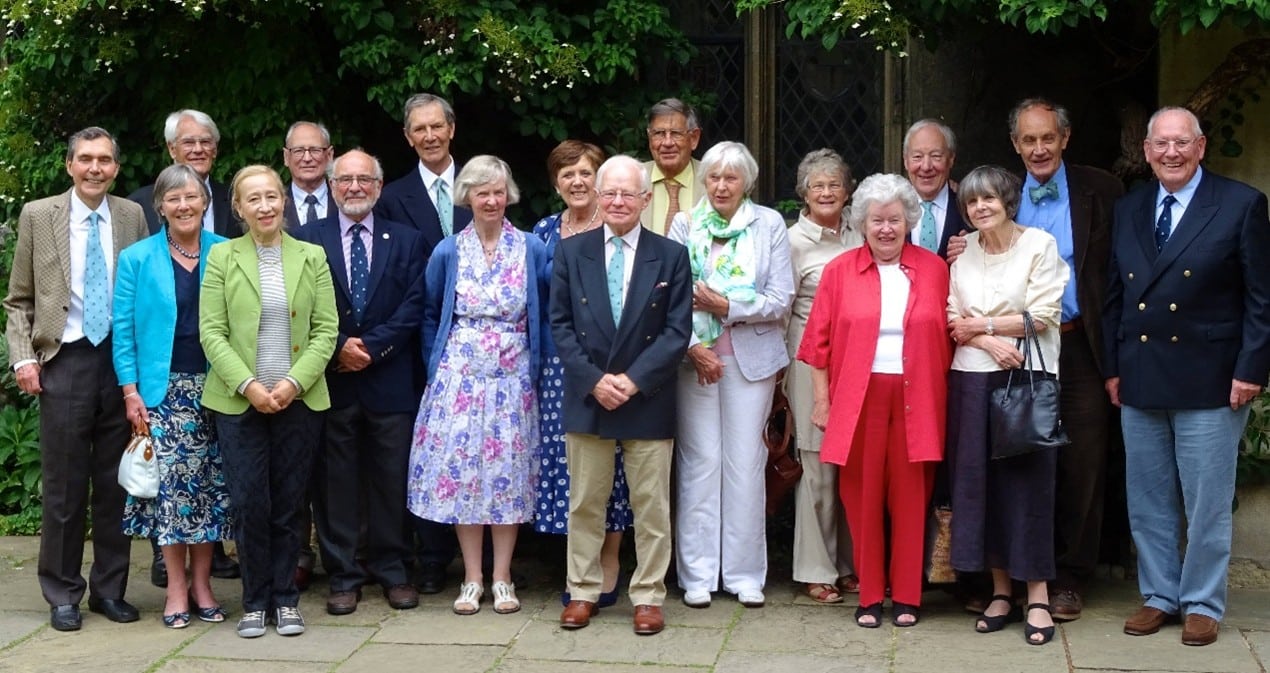
Some forty years after that, the idea of a reunion was born. With the help of the Development Office, I was able to contact all but one of the surviving members of the First Torpids and First and Second Eights from 1957 and 1958. Sadly, seven had died. Six of the survivors lived abroad, three were not fit enough to travel, but ten of us and eight wives met in College on Wednesday 8th July 2015 for an excellent lunch in the Beckington Room. Howard Lyle made a speech and we drank a toast to absent friends. It was a wonderful gathering – some of us had not met for more than 55 years, but we rediscovered the pleasure in each other’s company that we had experienced all those years ago. Indeed, we enjoyed it so much that those of us who were staying in Oxford met again in the evening for dinner. What tales there were to tell!
It hardly seems possible that that reunion took place more than ten years ago.
 ;
;