
Blog Post
Maria Murad awarded Justin Champion Doctoral Fellowship in Black British History
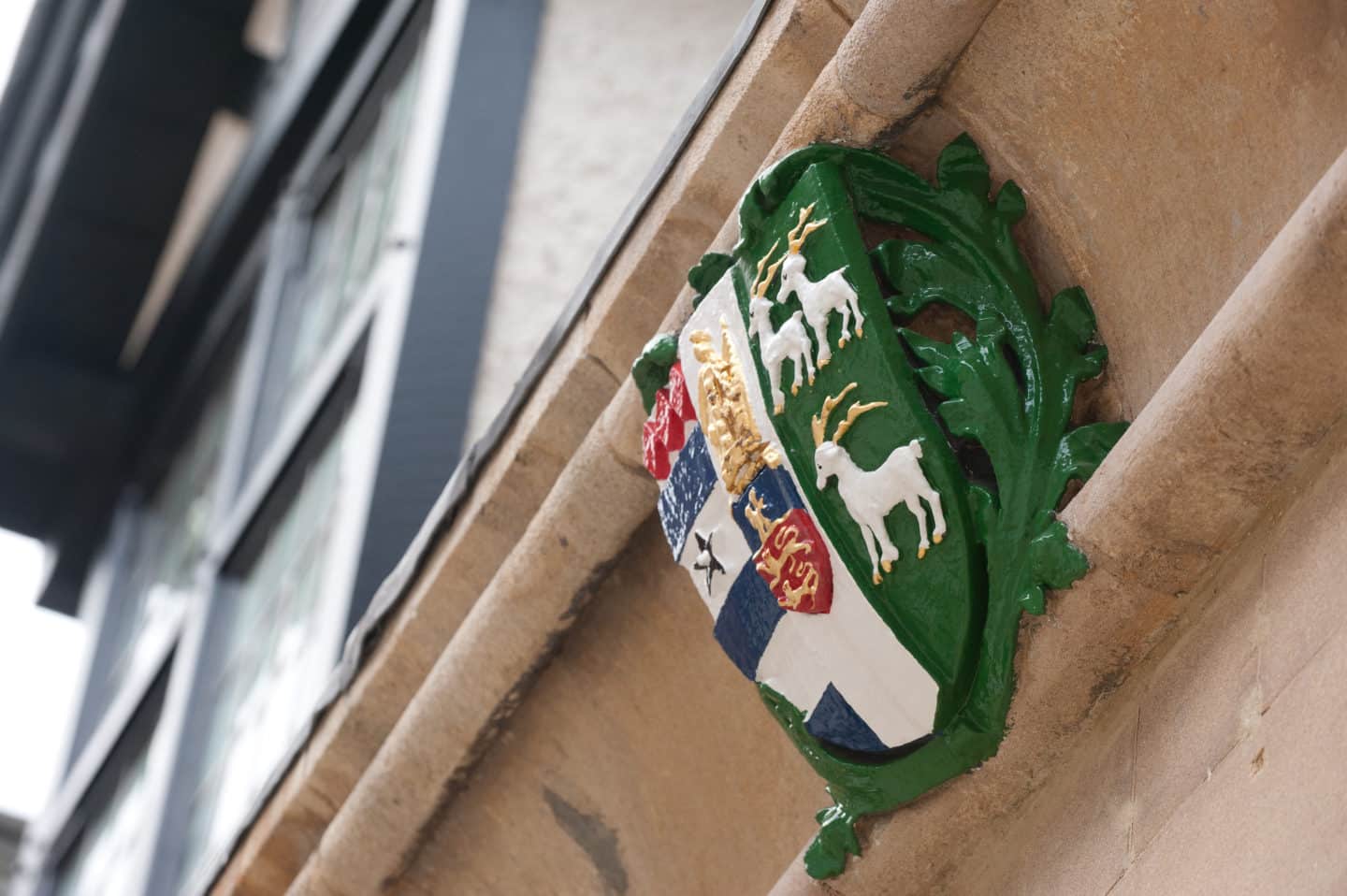
Maria Murad
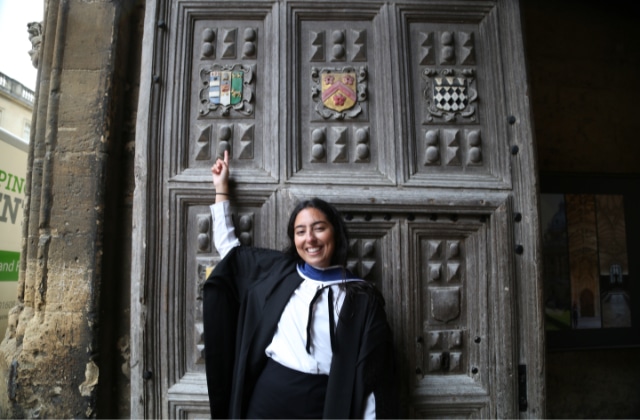
Congratulations to DPhil candidate, Maria Murad (2021), who has been awarded the Justin Champion Doctoral Fellowship in Black British History from the Institute of Historical Research. This Fellowship supports students in the writing up period of their graduate studies. Maria will spend six months in residency at the Institute of Historical Research in London and receive a grant to support her writing up period. A DPhil Candidate in Anthropology, Maria also pursued her MPhil in Visual, Material and Museum Anthropology at Lincoln.
Maria writes:
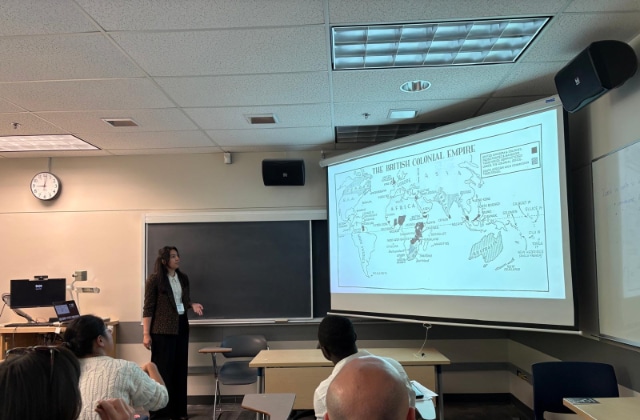
I am so excited and honoured to join the Institute of Historical Research this fall as a Doctoral Fellow. I look forward to workshopping and discussing my research, which specialises in the anthropological training of British colonial officers at Oxford and Cambridge in the 20th century with other interdisciplinarians working between history and other fields. This Fellowship would not have been possible without the academic support I have received at Lincoln. During my graduate studies, I have often found it difficult in the greater Oxford community to integrate myself into history circles, but this was completely remedied by the academic support I received at Lincoln.
There have been several instances where Lincoln community members have taken an interest in my DPhil topic and offered advice to enrich my research. During my Rectors’ Collections, former Rector Henry Woudhuysen encouraged me to apply to specific research grants, which I have used throughout my DPhil for archive trips, and current Rector Nigel Clifford has connected me with interlocuters at Cambridge with connections to the colonial training course whom I have interviewed. My college tutor, Dr Lydia Matthews, has always opened her door to me for a meeting if I ever needed some quick advice, and friends in the MCR like Dr Catherine Jenkinson have taken the time to read over my application materials and offer invaluable wisdom in a competitive academic market.
I have also worked as a student assistant in the Lincoln archives for the last four years and received an incredible amount of experience working with historical material like archives and material objects under the mentorship of the last three archivists: Lindsay McCormack, Dr Alison Ray, and now James North. Lindsay fueled my initial interest in the archives as a fresher and helped me curate an exhibition on Women in Lincoln History with my friend and Lincoln alum, Jack Norris. I continued to work with her to organise all physical student files from 1960 to 2019 which has given me organizational skills I carry with me in my doctoral research.
It was also Lindsay who spearheaded the Lincoln Medieval Seminar with Dr Laure Miolo, former Lyell Career Development Fellow in Latin Paleography at Lincoln, who both invited me to join. I had no background in medieval history, yet they allowed me as a complete novice in the field to join this working seminar where we transcribed medieval charters in the Lincoln archives. Laure taught me to read Anglo-Norman paleography, and this directly helped me learn to decipher the handwritten documents of professors on the colonial training course whose archives I view in the Bodleian.
Alison fed me new experiences in the archives like curating the Global Lincoln exhibition, teaching young students from Lincolnshire with objects, digitising archives, and more. Now, with James, I am learning how to catalogue new accessions into the Lincoln catalogue.
Not only have the archivists at Lincoln, along with Dr Laure Miolo, given me hands-on, experiential learning opportunities in history, but Dr Perry Gauci has also supported my project and taken supervision meetings with me, despite me not being his supervisee, to give me advice on conducting archival research on colonial history and on how to get teaching opportunities. His enduring support and generosity with his time has pointed my research in novel directions.
I am grateful to the Lincoln community for nurturing my interest in history, despite me being an anthropologist by training. This has led my doctoral research – a history of anthropology – to be in a much stronger position than it would have been otherwise. No place feels more like home to me outside of my hometown in Kentucky than Lincoln, and I am beyond grateful for the relationships I have formed here, which have propelled my academic interests into places I did not think possible. I look forward to taking these experiences with me to the Institute of Historical Research and am excited to build on the support I have received at Lincoln to form further connections with historians working at the intersection of disciplines.